HVIF™ · The Hybrid Value Investment Framework

A doctor's guide to self-directed investing.

Using a scoring system, a macro signal, and the discipline to wait — by a urologist who spent many years as a fairly poor investor, then built a framework to fix it.

The Independent Investor — publishing September 1, 2026.

The doctor relaxed on a sunset dock at the end of a good day
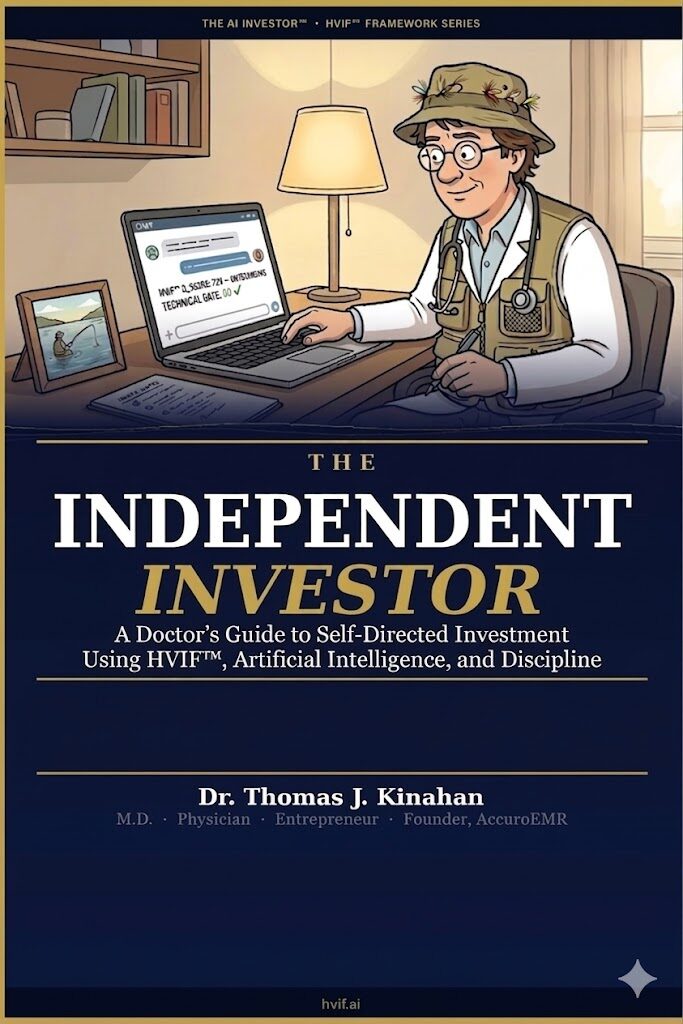
The Independent Investor — book cover
Publishing September 1, 2026
The Independent Investor
Pre-Order the Book
Problem

A costly advisor unwilling to explain his strategy.

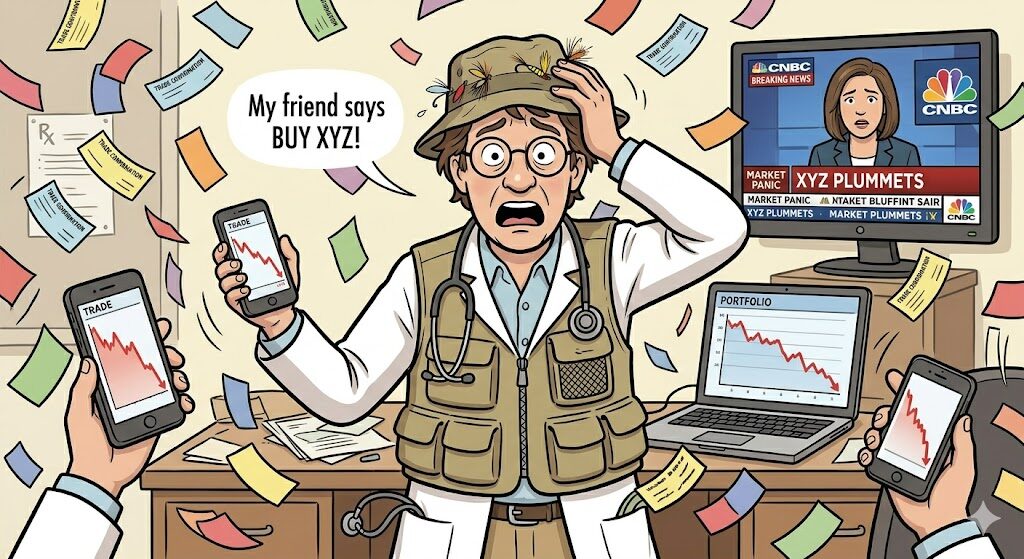
Before Doctor reacting to noise — hot tips, headlines, no clear strategy

Reacting to the noise

A friend's hot tip. A breathless headline. Four accounts, a hundred statements, and no honest answer to how any of it had performed. Every decision made on adrenaline and a 1%-of-assets annual fee — paid to someone whose strategy I couldn't describe.

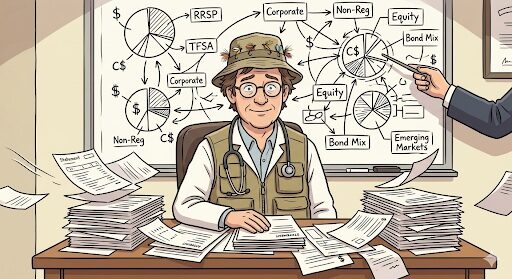
After HVIF™ Doctor calm at his desk, the same complexity now scored account by account

The same complexity — handled

Same four accounts. Same hundred statements. But every holding now has a score, every account a clear role, and every decision a written rationale. The complexity didn't shrink. It just stopped being frightening.

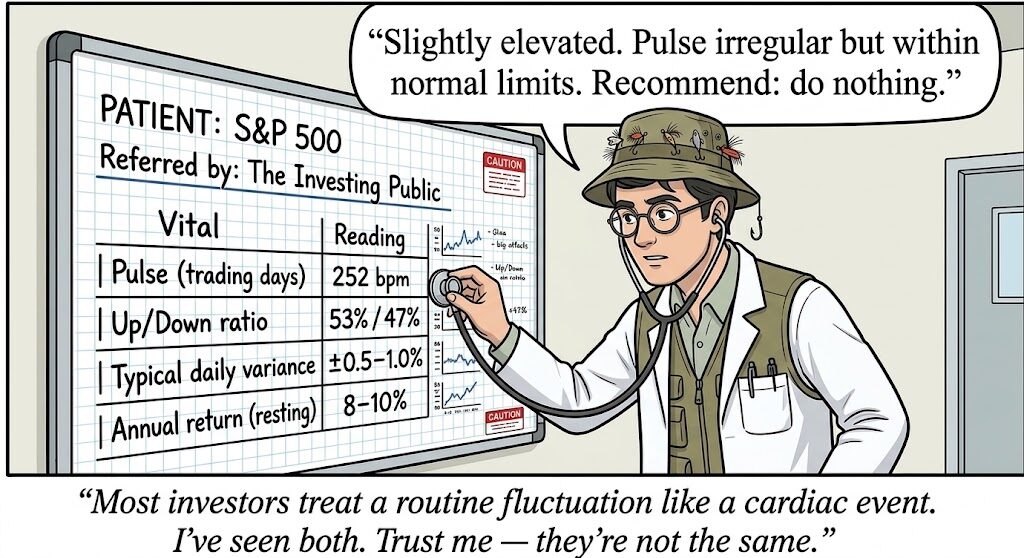
The doctor examining the S&P 500 like a patient with a stethoscope
The Idea

Invest the way a doctor makes a diagnosis.

A surgeon doesn't operate on a hunch. There's a workup, a differential, a checklist — the same careful process whether the patient is straightforward or not. HVIF™ brings that habit of mind to a portfolio.

HVIF™ stands for the Hybrid Value Investment Framework. Value — following Graham and Buffett — means paying attention to what the business is worth, not what its share price is doing this week. Hybrid means that quality alone isn't enough: the framework pairs fundamental analysis with wider market conditions and entry timing. The result is a repeatable process rather than a series of hunches.

Three signals. All three must agree before money moves.

One

Score the business

Q_SCORE rates a company on five pillars — moat, returns, earnings quality, valuation, and capital allocation — on a single scale. A high score earns a closer look. A low score saves you from a story that sounded better than it was.

Two

Check the conditions

The Tide grades the wider market: interest rates, the yield curve, credit spreads. It doesn't predict the future — nothing does — but it makes sure the weather is part of the decision rather than a surprise afterward.

Three

Confirm the timing

The Gate is a short entry check on the individual purchase. All three aligned — quality, conditions, timing — only then does capital move.

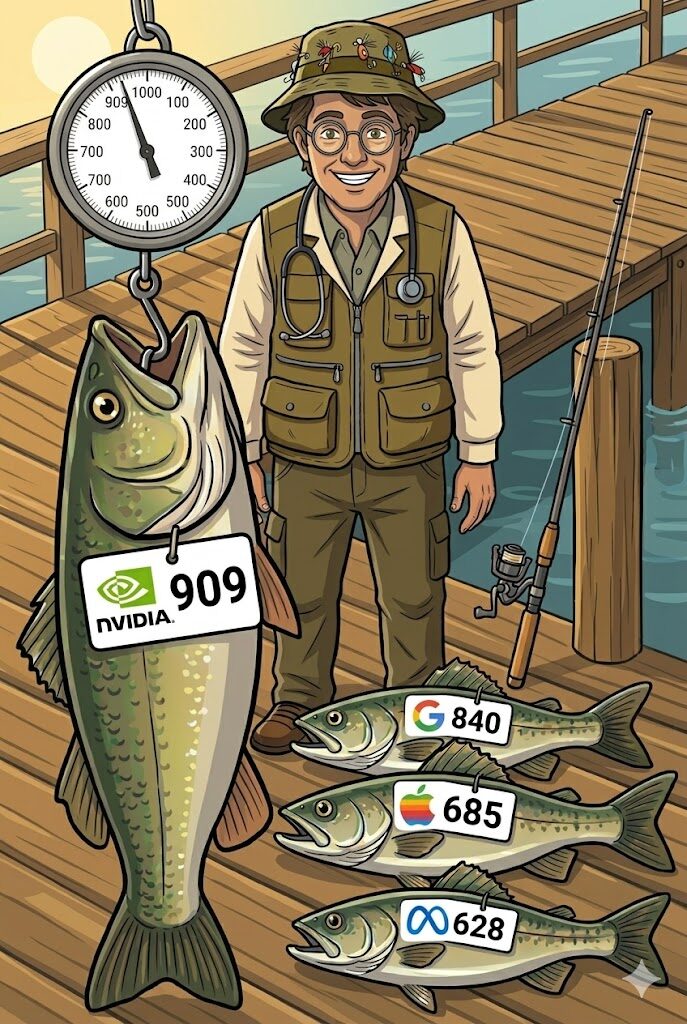
Fish on a dock tagged with company scores — bigger fish, higher Q_SCORE
Bigger fish, higher score. The keeper is the one worth landing.
The Scoring System

Q_SCORE — five pillars, one number.

Every business gets rated the same way, so comparisons mean something. No gut feel, no story stocks — a score you can defend, built from inputs you can verify.

P1 The Moat What makes a business worth owning at all.
P2 Compounder Returns on capital — does the business actually compound?
P3 The Cash Earnings quality — what the cash flow statement reveals.
P4 The Price Three independent valuation sub-scores. Don't overpay.
P5 Management What they do with the money.
800+  Elite 700+  Outstanding 600+  Strong Below 600  Justify or pass
The Second Signal

The Tide — conditions matter.

A good company bought into a deteriorating market is still a difficult position to hold.

The Tide weighs the things that quietly govern markets — interest rates, the shape of the yield curve, the spreads in the bond market — and produces one clear reading. At the calm end, conditions favour investing freely. At the other end, the sensible move is patience and cash. Most of the time it sits somewhere between, and says so plainly.

The Tide right now: moderate — quality names at ordinary sizing, nothing bold.
The doctor at a boat's helm
The doctor in a boat, landing a fish
The Payoff

Invest systematically. Not emotionally.

HVIF™ doesn't guarantee outperformance — no system can make that promise and mean it. What it does is give every decision the same structure: the same questions, in the same order, whether the market is rising or falling and whether you feel confident or not.

Used carefully over a few years, it took most of the worry out of managing my own money. The uncertainty didn't go away — it never does — but the way through it became clear. That turned out to be the part that mattered.

“To be a successful independent investor you need a framework, a little discipline, and a little help from artificial intelligence — and you need to know that no-one cares about your money more than you do.” — from the Preface

The Author

Thomas J. Kinahan, MDUrologist · Clinical Professor, UBC
Founding PhysicianAccuro EMR · QHR Technologies
Co-FounderSouthern Interior Medical Research Corp.
M.Sc. Health InformaticsUniversity of Victoria
Subspecialty TrainingHospital for Sick Children, Toronto
International SurgeryKenya · Rwanda · Tanzania
About the Author

“I do myself.”

My niece Caitlin, at age two, stopped her father from helping with her shoes with three words. She got them on the wrong feet — but she got them on. The independent investor, more or less exactly.

Tom Kinahan practised urology in British Columbia for thirty years while, by his own account, doing a fairly ordinary job of managing his own money. He founded AccuroEMR, built it from four employees to six hundred, and sold it to Loblaws in 2016 — which supplied both the capital to invest seriously and a hard education in what makes a business genuinely excellent, as opposed to merely exciting. He spent the next several years building a scoring system rigorous enough to replace the advisor's judgment with his own. The result is HVIF™, and this is the book that explains it.

He is not a licensed financial advisor. The book says so on page one.

Try It Out

Run the framework yourself.

The HVIF™ tools are in development for a 2026 launch alongside the book. Here's what's coming — join the waitlist and you'll get early access as each tier opens.

Single Score
Free

One stock, scored in full — on the house, after a verified email.

  • Enter any stock ticker symbol
  • Full five-pillar Q_SCORE
  • Written justification, not just a number
  • Current Tide reading included
  • Verified email sign-up required

Free single-stock scoring opens after the book launches. Join early access to be first in line.

Get Early Access
HVIF™ Full Access
$19.99 / month

The complete framework, live — unlimited scoring and ongoing analysis.

  • Unlimited stock & ETF scoring
  • Portfolio diversification analysis
  • Live Tide & Gate readings
  • Watchlist tracking & alerts
  • The complete HVIF™ v5.5 framework

Launching alongside the book in 2026. Pricing is preliminary.

Get Early Access

Pricing and features are preliminary and may change before launch. The HVIF™ tools are an educational decision-support framework — not investment advice, and not a recommendation to buy or sell any security. See the full disclaimer below.

Early Praise

Endorsements to be confirmed prior to publication.

The Independent Investor — book cover
Publishing September 1, 2026

Reserve your copy.

Pre-orders open soon. Add your email and you'll be first through the door — plus two things for getting in early:

  • The first chapter, free. An advance excerpt of The Independent Investor, sent straight to your inbox.
  • Founding-reader access to the HVIF™ tools. Including a standing allowance of free weekly stock scores, once the framework goes live.

We'll never share your address. Guaranteed not to be AI-generated.

Almost there Check your inbox — we just sent a confirmation link. Click it and your free chapter is on the way.
Inside the Book

Twenty-nine chapters, in three parts.

Part memoir, part method. Read it straight through, or start with the scoring system in Part Two and double back when you want to know where a rule came from.

Part One

The Apprenticeship

Chapters 1–9

Forty years of questionable decisions — a Vancouver Stock Exchange mining stock at twenty, the Microsoft that got away, fifteen years building AccuroEMR, a vineyard in the Similkameen. Each story ends with the lesson that became a named part of the framework.

Part Two

The Method

Chapters 10–24

The core of the book. The three-signal rule. Five quality pillars. Nine bond-market factors. Four Gate conditions. ETFs, cash, and diversification — each given the same rigour as individual equities, each chapter opening with the failure that made the rule necessary.

Part Three

The Season

Chapters 25–29

The current market through the HVIF™ lens. Surviving black swans. How artificial intelligence changed what is possible for the independent investor. A chapter on what it actually feels like when the framework works. And a final chapter on the most expensive trade — the one you didn't need to make.

Plus thirteen appendices — scoring worksheets, sector references, the Universe Discovery Pipeline, and the complete HVIF™ v5.5.5 master prompt.

🌊

Tide Table

Macro conditions and the EA‑BF reading.

📊

Scorecard

The five-pillar Q_SCORE in practice.

Math Dock

The equations and mechanics, plainly shown.

🎣

Field Notes

Stories from practice, markets, and the dock.